Fig. 2.4 / Case study
Understanding potential terrorist networks
Dynamic communicability on a network of 800,000 people and 4.5M communications: spotting influencers and emerging power by respecting the order of messages in time.
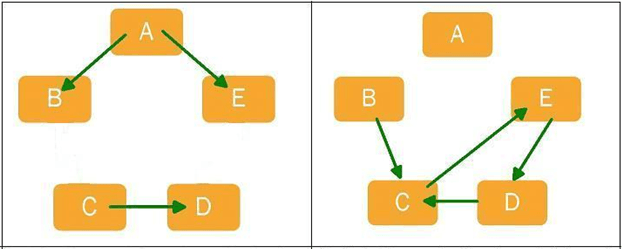
In this older case study, we show a recent method for analysing a large evolving network and have demonstrated how such a similar analysis might be useful in the fight against terrorism and organised crime. We demonstrate that we can calculate dynamic, evolving communicability measures for a social network of some 800,000 people containing 4.5million communications.
We can infer the most powerful people in the network through measures of their potential influence over the whole network. We can also spot emergent influencers and people gradually rising in power early on.
The key different with our approach is that we take account of causality due to the flow of time. A standard static network analysis that simply looks at who has contacted who (i.e., who is friends with who) misses out on a whole wealth of information captured in the timings of the communications.
The image on the right is a classic simple example. The left box represents the communications on Day 1 and the right box on Day 2. A traditional analysis would say that C is a key player since he/she sends and receives many messages. However, C could not have got a message through to A. On the other hand, if A says something interesting to B or E on Day 1, they could pass that message on to C and D on Day 2. Thus A has the potential to have sent a message to the whole network. In our measure A has the highest broadcast score.
An influencer can have a very high broadcast score (and hence high potential influence) without actually sending out very many messages. What is key is how people respond to your messages – do they pass them on or just ignore them.