Fig. 2.5 / Case study
Forecasting launch sales
Agent-based modelling of the Coke Zero launch, forecasting first-four-week sales to within 18% error.
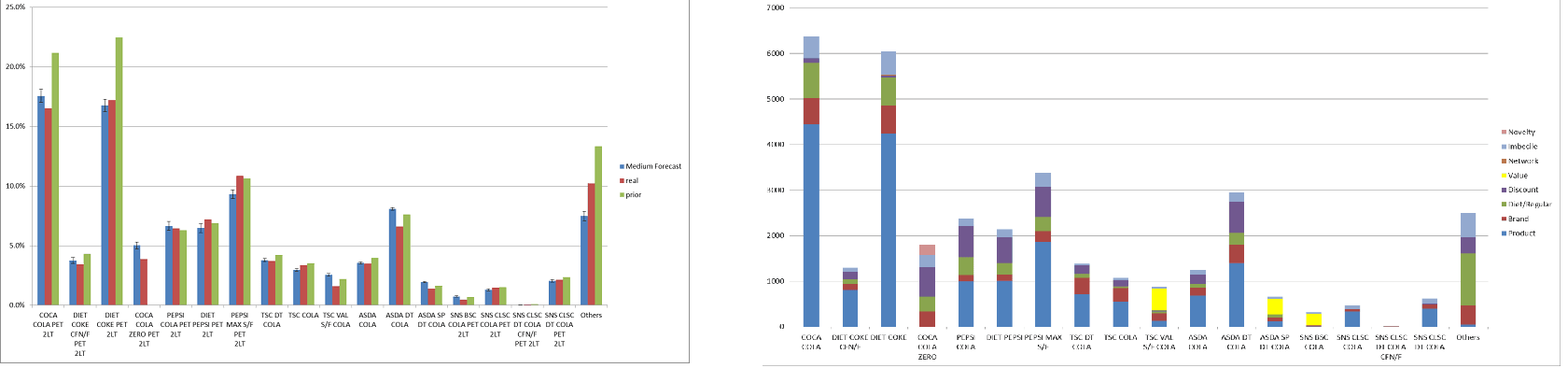
Disaggregated retail sales data has been underexploited in two significant and investable fields:
- Inference: using the data to infer why customers will choose one product over another, on some occasions, and not others, so as to optimise category and ranging decisions – such insight might be shared by the retailer with CPG suppliers (wining “share of mind”), or used to position their own label products better;
- Forecasting strategic changes, new product development, and range change scenarios, which are often one time decisions for which no immediate parallel experience exists in the past; such scenario forecasts must model behaviour and extrapolate the consistent and inconsistent behavioural traits of the customers rather than just their actual past purchasing.
Here we present analysis of a test case, investigating such an application to the launch of Coke Zero. By modelling the purchasing reasons within a category we are able to make forecasts for the launch sales of a new product under given marketing assumptions. The chart on the left shows the actual sales and the forecast sales for various products including Coke Zero using this agent-based modelling approach. Forecasting the launch sales of a new product is notoriously difficult and so even being in the right ballpark is a good result. To be as close as our model (an accuracy with an error of just 18% for Coke Zero sales over the first 4 weeks) is a major achievement. The chart on the right provides an automated breakdown of the purchasing reasons of the customers based on the model.